
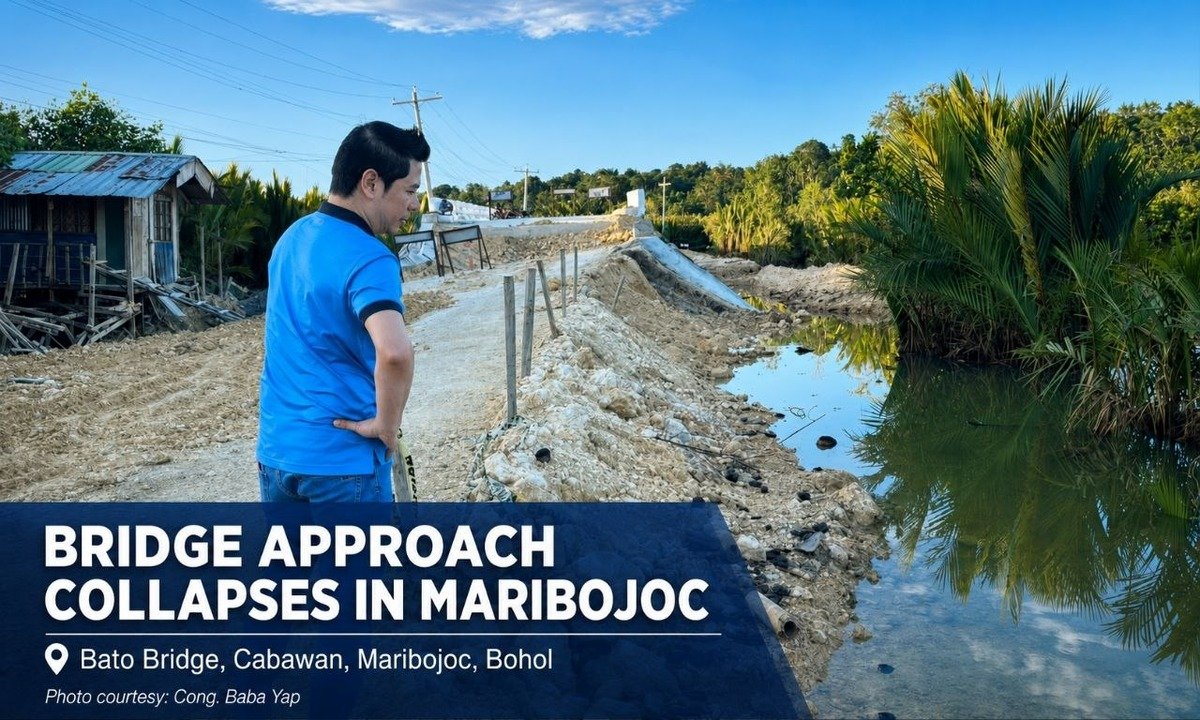
Less than a year after it was inaugurated, a newly built bridge in the western Bohol municipality of Maribojoc has been rendered impassable following the sudden failure of its approach road, leaving nearby communities without vehicular access and raising serious questions about the quality of construction and the suitability of the site’s soil conditions.
The structure in question — Bato Bridge, situated in Barangay Cabawan roughly 14 kilometers from Tagbilaran City — was built to strengthen road connectivity across western Bohol communities. It was completed and formally opened to motorists in late 2025, approximately one year after construction commenced in 2024. The collapse of the bridge’s approach section has now forced authorities to shut it down entirely to all motor vehicles.
How the Approach Section Gave Way
Based on reports gathered from the site, the failure originated beneath the limestone fill used as the approach road leading to the bridge. Over time, the soil underneath that fill eroded and gradually subsided, causing the approach section to sink before ultimately collapsing. Residents in Barangay Cabawan had reportedly observed cracks forming on portions of the structure several days before the approach gave way entirely, yet no formal precautionary closure was ordered prior to the incident.
According to accounts from local residents, the bridge was built on soft ground — a factor widely regarded as a significant risk to structural integrity when not properly addressed during construction. Persistent heavy rains and recurring flooding in the months before the collapse are believed to have worsened the situation by saturating the ground beneath the fill material, accelerating the erosion process and hastening the eventual failure of the foundation.
Engineers and infrastructure experts have long identified approach slab failure as one of the more common structural problems in Philippine bridge construction, particularly in areas characterized by high rainfall, poor soil stability, and inadequate drainage. Proper soil compaction, the installation of effective drainage systems, and thorough geotechnical assessment are considered essential safeguards — especially in low-lying or flood-prone areas like parts of western Bohol.
Residents Bear the Brunt of the Closure
With Bato Bridge now closed to vehicular traffic, affected residents on both sides of the damaged structure have been forced to take an alternate foot route stretching approximately half a kilometer from the national highway to reach the bridge vicinity. Some individuals have reportedly been crossing through the side of the bridge on foot to get to the other end — a makeshift solution that raises fresh safety concerns given the unstable state of the surrounding area.
The closure has had immediate and tangible consequences for the livelihoods of those who depend on the bridge. One resident identified only as Grace — whose surname was not disclosed at her request — told reporters that her mineral water delivery business has been directly affected because the route for transporting goods across the area now requires vehicular access that is no longer available.
Grace’s situation reflects a broader economic strain felt across the community. Small business owners, farmers, commuters, and service providers who relied on Bato Bridge as part of their daily movement have no immediate alternative vehicular crossing in the vicinity. The western Bohol communities served by the bridge are now left with a significant logistical gap that shows no quick resolution.
Representative Baba Yap Inspects Site, Issues Directive to DPWH
In response to the incident, Bohol district Representative Baba Yap traveled to Barangay Cabawan to personally inspect the damage at Bato Bridge. In a statement published on his official Facebook page, Rep. Yap confirmed that he had visited the site following the collapse and acknowledged that the bridge project had started in 2024.
“I visited the bridge after it collapsed a few days ago, noting that the project was started in 2024. I have instructed the Department of Public Works and Highways and the contractor to speed up the repair and rehabilitation works so the bridge can be reopened as soon as possible and residents will no longer be inconvenienced by detours,” Rep. Yap stated in his Facebook post.
According to Rep. Yap’s statement, rehabilitation work at the site has already begun. His office indicated it would continue to monitor the progress of repairs and ensure that the contractor complies with the directive to accelerate the work. However, the congressman did not provide a specific timeline for when repairs would be completed or when the bridge would be reopened to vehicular traffic.
As of June 11, 2026, no formal public statement had been released by the Department of Public Works and Highways (DPWH) or by the construction contractor responsible for the original bridge project, according to available reports.
Questions Over Construction Quality and Timeline
The fact that Bato Bridge failed less than a year after it was opened to the public has drawn scrutiny toward the quality of construction, the adequacy of soil preparation, and the sufficiency of drainage infrastructure installed at the site. Residents specifically pointed to the soft ground conditions as a likely contributing factor, though no official engineering report confirming or refuting this assessment had been publicly released as of this writing.
According to standard DPWH protocols, investigations into approach slab failures typically examine whether proper soil compaction procedures were followed, whether drainage systems around the bridge perimeter were correctly designed and installed, and whether site conditions were adequately assessed prior to construction. The outcome of any such inquiry can lead to findings ranging from contractor negligence to design flaws or, alternatively, force majeure resulting from extreme weather events.
It remains unclear at this stage whether the ongoing structural assessment will result in formal liability determinations against the contractor or the supervising engineers involved in the original project.
Assessment Underway, Final Findings Not Yet Released
Authorities confirmed that as of June 11, 2026, a comprehensive assessment of the structural failure at Bato Bridge was still ongoing. The investigation is expected to identify the precise cause of the collapse, determine the full extent of damage to the approach section and its supporting foundation, and inform the technical specifications of the rehabilitation works currently being carried out at the site.
No additional legislative or regulatory actions related to the incident have been announced as of this report. Rep. Yap’s office has committed to providing public updates on the progress of repair work and to ensuring that the bridge is structurally sound before it is reopened to traffic.
Community Waits as Repairs Begin
For the residents of Barangay Cabawan and the surrounding barangays of Maribojoc, every day without a functioning bridge translates into added difficulty — longer walks, disrupted deliveries, and reduced access to basic goods and services. The municipality of Maribojoc, located approximately 14 kilometers west of Tagbilaran City, has not issued its own formal statement on the matter as of June 11, 2026.
The community’s hope now rests on the speed and thoroughness of rehabilitation efforts underway at the site, and on the commitment of both Rep. Yap’s office and the DPWH to see the repairs through to a safe and timely completion. Until then, residents continue to navigate the disruption as best they can — on foot, through detours, and with the uncertainty of an unspecified reopening date still hanging over the bridge and the community it was meant to serve.
Originally reported by: Bohol Chronicle / wire reports